The Chicago Bears may look like they are up against the salary cap, but looks can be deceiving. @Johnathan_Wood1 examines the numbers.
The Chicago Bears finally delivered a fun season for their fans in 2025, posting a winning record for the first time since 2018, winning a playoff game for the first time since 2010, and giving hope for a future filled with sustained success thanks to a bevy of young offensive talent and a head coach who knows how to use it.
Unfortunately, that ride has now ended, so now focus shifts to the offseason, where the Bears will look to shore up their weaknesses and enter 2026 as legitimate Super Bowl contenders. To get us ready for the next few months, this article will be your one-stop shop for where things currently stand. Questions we’ll answer include:
- Who is under contract for 2026?
- Who are the primary free agents?
- How much salary cap space do the Bears have?
- What are their options to create more space?
Let’s dive right in!
Current Depth Chart
The picture below shows my best guess at the Bears’ current depth chart for the 54 players they currently have under contract for 2026 (including the 14 players they just signed to reserve/future contracts).
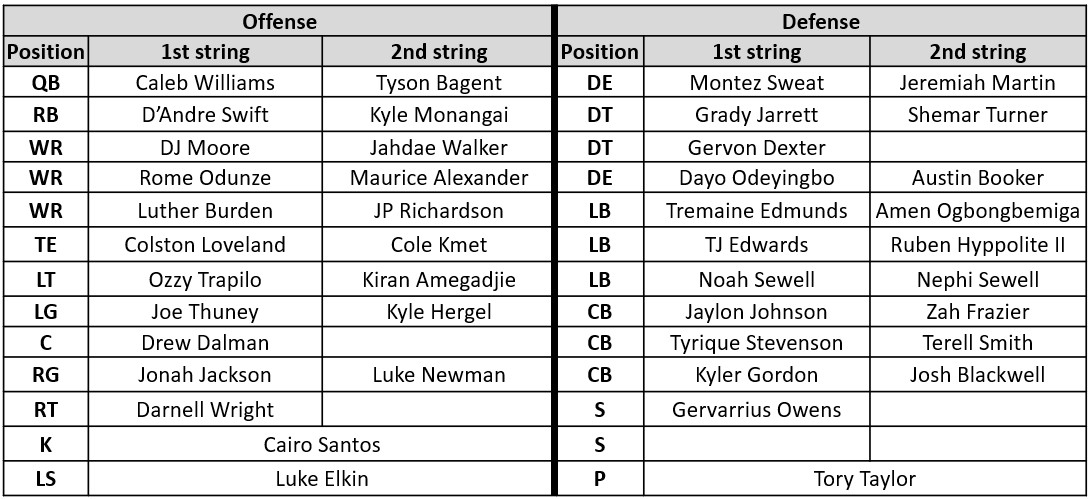
A few thoughts:
- A few of the players under contract didn’t make the list because they would be 3rd or 4th string. This happened at RB, TE, and CB.
- Looking at this list, there are several clear positions of need:
- Left tackle: Ryan Poles recently said Ozzy Trapilo’s injury will push deep into 2026, so the Bears can’t count on him.
- Defensive End: Dayo Odeyingbo, one presumed starter, tore his Achilles tendon halfway through the year, putting his status for 2026 in doubt. Even before getting hurt, he wasn’t good enough, and the Bears need a solid starter here to pair with Montez Sweat and push Austin Booker to DE3.
- Defensive Tackle: Neither Grady Jarrett nor Gervon Dexter were very good in 2025. The Bears need a high-quality starter here.
- Linebacker: Presumed starter TJ. Edwards fractured his fibula in the Wild Card game, leaving the Bears in need of a replacement in 2026.
- Safety: Gervarrius Owens, the only player under contract, is somebody I had never heard of before doing this. He spent the season on Chicago’s practice squad, as everybody who was on the actual roster is currently a free agent. The Bears need 2 starters here, plus a top backup.
Free Agents
The following players are unrestricted free agents, meaning they are free to sign with any team when the new league year begins. Players who started at least 4 games or played at least 35% of snaps on either offense or defense are indicated with an asterisk (*).
- Quarterback: Case Keenum
- Running back: Travis Homer
- Wide receiver: Olamide Zaccheaus*, Devin Duvernay, Qadir Ismail
- Tight end: Durham Smythe
- Offensive Tackle: Braxton Jones*
- Interior OL: Ryan Bates, Ricky Stromberg
- Defensive Tackle: Andrew Billings*, Chris Williams
- Defensive End: Joe Tryon-Shoyinka, Daniel Hardy, Dominique Robinson
- Linebacker: D’Marco Jackson*, Jalen Reeves-Maybin, Ty Summers
- Cornerback: Nahshon Wright*, Chauncey Gardener-Johnson*, Nick McCloud*, Jaylon Jones
- Safety: Kevin Byard*, Jaquan Brisker*, Jonathan Owens, Elijah Hicks
- Special Teams: LS Scott Daly
There are 9 players on this list with an asterisk, indicating they were key contributors in 2025, but I don’t know how many of them the Bears want back. I imagine one of the two starting safeties likely returns, and maybe depth pieces forced into a larger role like D’Marco Jackson and Chauncey Gardener-Johnson is the price is right, but the majority of these players are likely either moving on or coming back to the Bears on very small deals.
The Bears also have a few players who fall into two other free agent categories:
- Restricted Free Agents: IOL Jordan McFadden and DE Daniel Hardy
- The Bears can put a one-year tender on these players, restricting their free agency. A $3.5M tender gives Chicago the right to match any other offer, while a $5.7M tender forces another team to give up a 2nd round pick to sign them.
- Both of these players are depth pieces, with Hardy mainly a special teams player, so I would guess the Bears don’t think either are worth the $3.5M tag, but I wouldn’t be surprised to see both back in camp on minimum salary deals fighting for a roster spot.
- Exclusive Rights Free Agent: OT Theo Benedet
- The Bears can put a one-year minimum salary tender on Benedet, and he will be unable to negotiate with any other teams. He will be back in Chicago next year.
Salary Cap Situation
Now that we’ve seen needs and possible players to re-sign, let’s shift gears to thinking about how much money Chicago will have to work with this offseason. The table below shows a general overview of the Bears’ current salary cap situation for 2026. All salary cap information comes from Over the Cap.
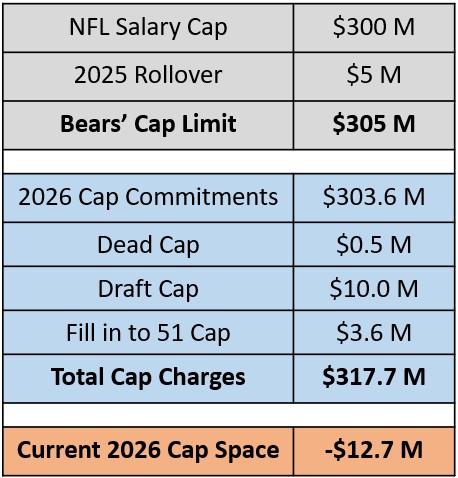
A few caveats on these numbers:
- There is no set salary cap yet, but most estimates have it around $300M, so that’s what I used.
- The total cap charges are different than what you see if you just look at Over the Cap in two ways:
- They include the projected cost for signing 2026 draft picks, based on 2025 cap hits of players taken at the same position.
- They fill in to the 51 players that count on the offseason salary cap, assuming players filled in have the minimum salary of $900,000.
- Over The Cap doesn’t have the reserve/future contracts yet, so they only have 40 players under contract. The Bears currently have 7 draft picks, so that left 4 players to fill to 51.
The main takeaway here, then, is that the Bears are actually over the salary cap by close to $13M right now. That might seem alarming at first, but actually isn’t a huge deal. There are always ways to free up cap space, as we’ll see below.
Cap-Clearing Options
Chicago is about $13M over the cap, and probably needs to go into training camp with about $10M in wiggle room for in-season moves, so they realistically need to clear at least $23M or so just to be cap compliant for 2026. Any upgrades they want to make besides draft picks and minimum-salary players will require additional space to be cleared, so Chicago has their work cut out for them to free up space in the next few months.
The easiest way to clear cap room is to cut players. The table below shows every player who would generate at least $2M in 2026 cap space if they are cut this offseason. I want to be extremely clear that I am not advocating for cutting all of these players, simply providing a list of every possibility.
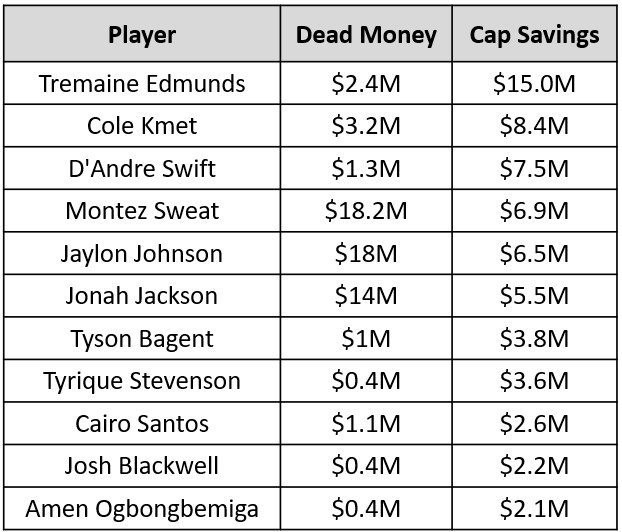
A few thoughts:
- Tremaine Edmunds seems like a lock to get cut. He’s a fine player, but not worth the salary, and the Bears need that money.
- Going into the season, I had assumed that Cole Kmet and D’Andre Swift – the two players who could clear the next most money – would both be gone, but now I don’t think they are.
- Even with the emergence of Colston Loveland demoting him to TE2, Kmet still plays a ton of snaps, and I think the Bears try to lower his cap hit while keeping him around.
- Swift was a top 10 RB this year while getting paid the 16th highest average salary, and it doesn’t make sense to cut him when he’s outperforming his contract.
- Montez Sweat, Jaylon Johnson, and Jonah Jackson are all core starters who aren’t going anywhere.
- Amen Ogbongbemiga and Josh Blackwell are core special teamers. The Bears will have to decide if they value them enough to keep them around or need that $4.3M in cap room more dearly.
- The deals the Bears would most like to get out of are not on this list. They handed out new deals last offseason to TJ Edwards, Dayo Odeyingbo, and Grady Jarrett, which means all 3 would actually have higher cap hits if they are cut than if they stay on the roster. The Bears are stuck with them for 2026, their penance for handing out those three contracts that were obviously terrible the moment they were signed.
- DJ Moore is also not on this list because he has a large guaranteed salary for 2025, but the Bears could trade him and move that salary to a new team, which would free up $16.5M in 2026 cap room. Given the reality of their cap situation and the abundance of young talent at WR on the roster, I assume that is coming this offseason.
Trading Moore and cutting Edmunds, the two obvious moves, free up around $31.5M in 2026 cap room, which puts the Bears under the cap, and leaves them about $8M to upgrade the roster after accounting for signing draft picks and leaving room for in-season moves.
Given that, it would leave the Bears needing starters at WR, LT, DE, DT, MLB, OLB, FS, and SS. So, $8M plus the draft wouldn’t be enough, so Chicago is going to have to clear more room to meaningfully upgrade the roster. Thankfully, they have the ability to do that fairly easily by restructuring players.
The way that this works is you convert 2025 salaries into bonus money, which doesn’t impact the cash players get, but moves some of the cap hits to the future. You can spread those out over up to five years. The table below lists every player with a salary over $5M, which means restructuring could save up to $4M on the 2025 cap. Once again, I want to emphasize that I am not advocating for restructuring all of these players, simply providing a list of every possibility.
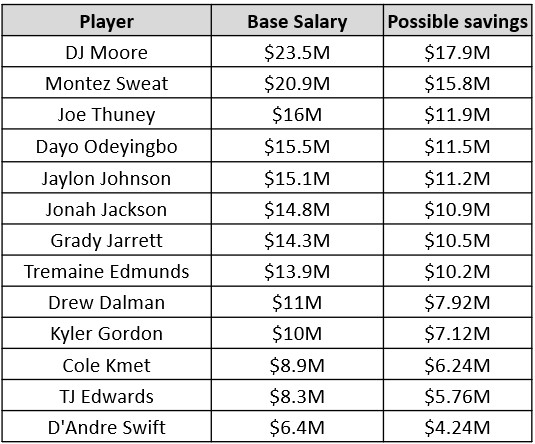
A few thoughts:
- If every player on this list was restructured as much as possible, that would clear over $130M in 2026 cap room. However, it is worth noting that this is not free cap space. It simply takes 2025 cap hits and moves them to future years, putting the Bears’ cap situation in those seasons on more tenuous ground.
- It makes sense to do this sometimes when you are in a contention window, which the Bears are, but you still want to pick and choose who to do it with carefully. Most notably, you don’t want to push dead money to the future for players who are not in your long-term plans, because that all of the dead cap hits count immediately when a player leaves the roster.
- This includes guys I think won’t be on the roster in 2026, so DJ Moore and Tremaine Edmunds (as I noted above).
- It also includes players who aren’t living up to their contracts and are likely going to be cut after 2026, which includes Dayo Odeyingbo, TJ Edwards, and Grady Jarrett.
- Players who are in the teams’ long-term plans are logical restructure candidates. From this list, the most likely candidates to me are Jonah Jackson, Drew Dalman, and Kyler Gordon.
- Restructuring those 3 for the maximum amount would open up around $26M in 2026 cap space, giving the Bears about $34M to work with in free agency if coupled with the trades/cuts suggested above.
- Beyond those three, it gets murky. The remaining players could be considered, but bring some risk with them:
- Joe Thuney and Montez Sweat: I grouped these two together because they’re both playing solid football but are aging. How much longer do you bank on them being around, and how much dead money are you willing to absorb if they retire (Thuney) or get cut in a year or two?
- Jaylon Johnson: That would be an extreme vote of confidence for him returning to form after an injury-plagued 2025.
- Cole Kmet: He’s the TE2 long term. That’s probably not worth the $12M a year he’s currently getting paid. At some point, possibly next offseason, it will make sense to replace him with a cheaper player, so moving money to the future could be risky.
- D’Andre Swift: he only has 1 year left on his contract, and he’ll be 28 after the 2026 season. I don’t think he’s likely in Chicago past 2026, so then I don’t think it’s a good idea to move money to the future on his deal.
I’ll be curious to see how aggressive the Bears are with restructures this offseason. They haven’t needed to do restructures for several years now, as they were rebuilding and had an abundance of cap space, but now they shift to tight cap situations while in a contention window. Hopefully, they can maintain the right balance of aggressiveness and practicality to both build a strong roster for now while not hampering their ability to continue contending for years to come.
Category: General Sports