Hitting is hard. Tolle can make it harder.

Hitting is hard. I could barely do it when I was 14, playing on the freshman team in Western Massachusetts, where the talent pool isn’t full of future major leaguers. If the pitchers started throwing 97 mph with wipeout sliders and mind-bending changeups, I probably would have started writing about the game about 10 years earlier than I did.
I’ve carved out a niche on this website as the guy who tries to explain pitch sequences and why they work. A high fastball can set up a low curveball. A sinker on the inside of the plate might help you escape a jam. Watching the game and trying to deduce what’s coming next is part of why I love baseball. It’s the world’s most complicated game of rock-paper-scissors played at 100 mph. At least, so I thought.
Stumbling through statistics after the Red Sox season ended, I noticed an interesting trend. Since pitch tracking was introduced in 2008, 2025 was the first season during which more than half of all pitches thrown were in the strike zone. The number has slowly been on the rise over the past several seasons, and 2025 was the first time it eclipsed the 50% mark.

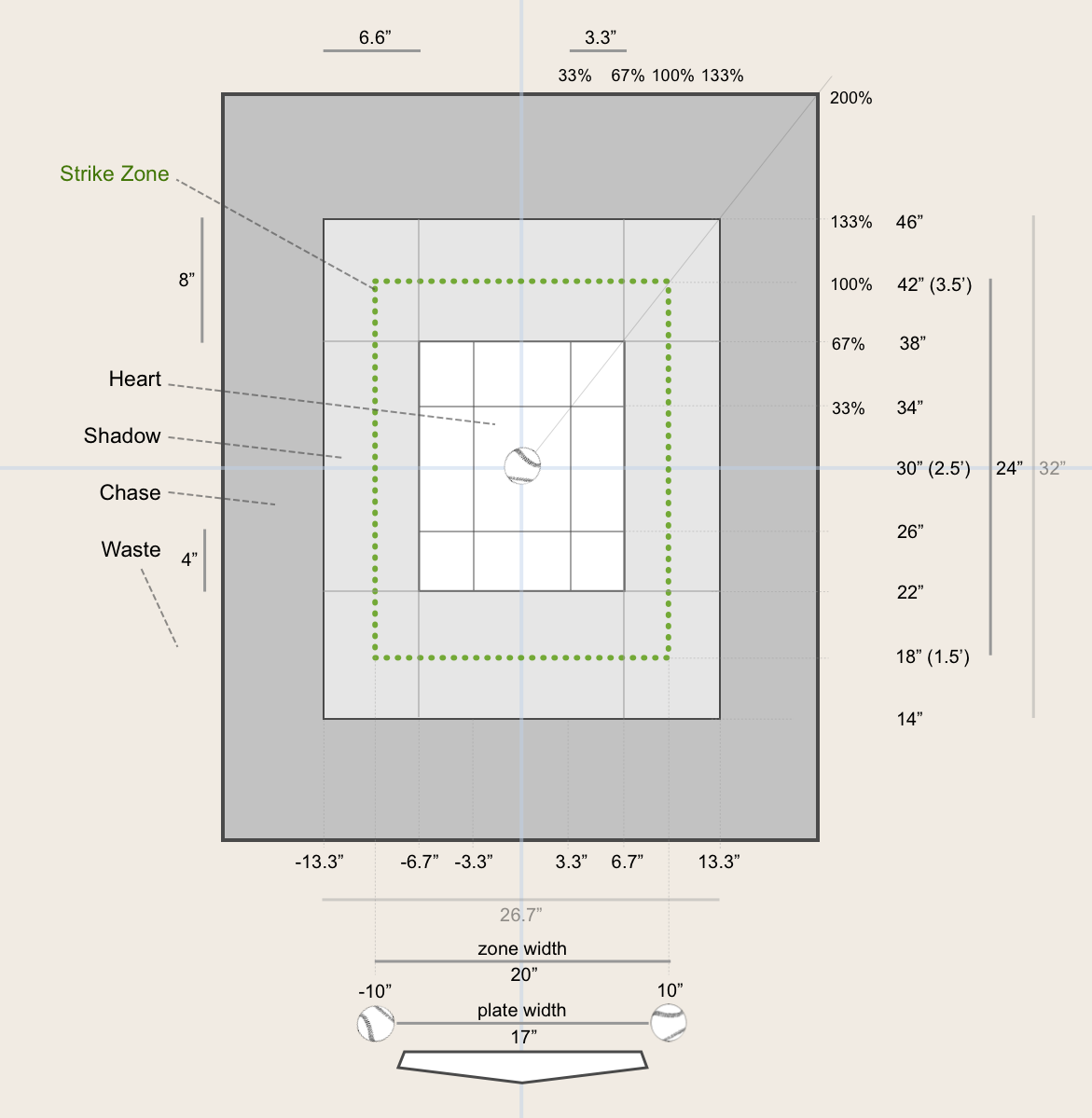
While the increase might seem small, with upwards of 700,000 pitches thrown across the league in a given season, the shift is clearly intentional. But why? Well, because hitting is hard. Here’s a look at pitcher run values per 100 pitches on swings, sorted by zone.

Hitters, as a whole, are best served only swinging at pitches right down the middle. On average, swinging at just about anything else is a positive for pitchers. Pitching is better than it ever has been before. Velocity is up, and arsenals are deeper. In 2008, 78.8% of pitches thrown in 3-1 counts were four-seamers or sinkers — they averaged 91.2 mph. In 2025, four-seamers and sinkers accounted for only 65.8% of 3-1 pitches and averaged 94.1 mph. Hitters used to see 3-1 fastballs because that’s what you were “supposed” to throw, but more recently, organizations have stopped doing hitters favors.
There are obviously exceptions. Rafael Devers can hit a pitch off the ground for a home run. Shohei Ohtani has taken neck-high fastballs out of the park. Good pitches get hit sometimes, but as Dan Haren said, “People pop up in batting practice.” In 2016, August Fagerstrom wrote about Haren’s tweet for FanGraphs. Haren threw strikes at 88 mph and got away with it.
Eventually, with all trends, the scales tip. How often can you throw the ball in the zone without getting crushed? What pitch types or sequences allow you to live in the zone? In truth, I don’t know. I pored over stats, ran queries, direct messaged Driveline Founder Kyle Boddy on Twitter, and went on an ayahuasca retreat to find answers, but the key to pounding the zone successfully never revealed itself to me.
However, one thing stood out among successful high zone rate pitchers — they throw multiple types of fastballs. Bryan Woo, Joe Ryan, Trevor Rogers, and Brandon Woodruff all throw four-seams or sinkers over 55% of the time and have zone rates over 55%. In more anecdotal evidence, Cam Schlittler threw 70% four-seamers and sinkers against the Red Sox in Game 3 of the Wild Card Series. Those fastballs held a 68% zone rate. It makes sense why it works, too. Squaring up a baseball is incredibly difficult. You have to swing at the right angle, at the right time, with a split second to make a decision. I’ve never hit at a level high enough to have to do much other than react to the pitch, but differentiating between two pitches that are spinning the same direction but have significantly different movement patterns feels nearly impossible.
Aside from reminding you that some dude who willingly lives in Southie during the offseason ended the Red Sox season, there is a reason I’m publishing this on a Red Sox website. Payton Tolle debuted in August and dominated the Pittsburgh Pirates using 60% four-seam fastballs. In his next start, he tried to run that same gameplan back, but the Diamondbacks were ready. Leading up to the game, they turned the pitching machine all the way up and refused to let the fastball beat them. Of 39 fastballs he threw, he generated only three whiffs while Dbacks’ hitters fouled off 13. His cutter, curveball, and changeup each held zone rates below 50%. Tolle’s only reliable pitch to throw in the zone was his four-seam, so Arizona could sit on it and fight them off until they got one to handle. He only made three starts before moving to the bullpen, but his lack of secondary pitches to throw for strikes was quickly exposed.
The common recommendation from analysts, players, and Tolle himself has been to improve his secondary pitches — the cutter and changeup. But what if, rather than turning the ball over or cutting it more often, he just started throwing a sinker? He already throws hard and has huge extension. If he has two fastball shapes to throw in the zone instead of just one, it’s that much harder to set your sights above the rising four-seam and wait for one to hit. Hitters have a difficult time damaging pitches that aren’t down the middle, but if they know what’s coming, it’s a bit easier. FanGraphs’ Justin Choi came to similar conclusions. He found that using sinkers and four-seams early in counts was a great way to limit early damage.
Circling back to the original point, the only pitches that consistently return positive results to hitters are those down the middle. That’s why count leverage is everything. Pitches in the “shadow” zone (roughly one ball width inside and outside the strike zone) returned a .268 wOBA last season; pitches in the “heart” zone returned a .356 wOBA. Behind in the count, hitters are forced to be more aggressive and swing at those pitches. In 0-0, 1-0, and 2-0 counts, hitters swung at 35.1% of pitches in the “shadow” zone. In 0-1. 0-2, and 1-2 counts, that number rose to 64.6%. If you can get ahead in the count, everything else gets a little bit easier.
It’s not just early in counts either. Let’s use Bryan Woo as the proof of concept, because he’s the most extreme example, throwing a four-seam or a sinker about 73% of the time. In two-strike counts, Woo threw his four-seamer 48.2% of the time. Rather than filling up the zone with it, he elevated to induce swings and misses. Here’s a look at his heatmap by count, featuring this cool slidey thing.


With two strikes, there’s a very clear intent to elevate from Woo. This approach yielded a 22.2% putaway rate, well above the average for a fastball. His fastball is very similar to Tolle’s, as well. Woo’s velocity was a touch lower than Tolle’s, though the latter likely saw gains from debut adrenaline and working out of the bullpen. Tolle’s comes with more extension, however, helping the velocity play up even further. Additionally, they have nearly identical attack angles, making it even more difficult to hit when located properly.
Everyone will tell you that Tolle needs to spin the ball more to survive in the majors. While he does need to establish that he can change speeds, he doesn’t need to start throwing 35% breaking balls and changeups. If you still don’t believe me, take a look at Bryan Woo’s month of August. He threw 31.2 innings with a 2.27 ERA and 31% strikeout rate. He used a fastball or a sinker 81%(!!!) of the time.
Will it work for Tolle? I don’t know. Woo has impeccable command, and his fastballs have two very distinct shapes. Tolle showed a tendency to lose the feel for his pitches, and doesn’t currently throw a sinker. Maybe the best sinker he can throw doesn’t really sink, and the past 1,300 words have been meaningless. It’s also admittedly lazy to take one of the game’s best pitchers and say, “He does it, why can’t this guy?”, but Woo is just one example of how fastballs in the zone can go a long way. If you have the stomach for it, watch Cam Schlittler’s start in the Wild Card series. He throws fastball after fastball after fastball in the zone, and the Red Sox didn’t barrel a ball all night.

Schlittler wasn’t perfect. He didn’t dot the edges with each pitch, but he did get ahead of hitters and force them to swing at pitches that don’t typically yield great results. Of 107 pitches, he threw just 19 behind in the count.
There’s more than one way to skin a cat get hitters out. Blake Snell is partially who led me down this rabbit hole in the first place, and he’s ridden one of the lowest zone rates in baseball to two Cy Youngs and the highest K/9 in baseball history. Max Fried finished fourth in Cy Young voting, using four-seams and sinkers just 30% of the time. Corbin Burnes has made a few hundred million dollars with a cutter and some spin. Adding a sinker won’t magically turn Tolle into a top-ten pitcher in baseball, but it might be a way to stay ahead of hitters and let his four-seam eat.
Category: General Sports