
Corbin Young previews the starting pitcher position for 2026 fantasy baseball, giving you his top sleepers and fades.
We’re in the age of advanced metrics, Statcast data and pitcher “stuff” being the top headlines in real-life and fantasy baseball. Fastball velocity has been increasing each season, with an average velocity of 93.6 mph — the highest in the Statcast era (since 2008). We’ve seen fastball velocity gradually rise, averaging over 93 mph for four straight seasons after hovering between 92-93 mph throughout the 2013 to 2021 seasons.
With more “stuff” models and advanced data telling us non-fastballs might be more optimal, we’ve seen the percentage of fastballs fall to 54.8% in 2025, with a consistent decline since 2019. For context, 2019 was the first season where the league-wide fastball usage was below 60%.
So, what pitch types increased the most over the past few seasons?
[Join or create a Yahoo Fantasy Baseball league for the 2026 MLB season]
Sweepers and sliders have taken the league by storm, with the usage hovering between 20-22% over the past four seasons (2022-2025). When we filter by sweepers specifically, it went from a 2% usage in 2021 to 4% in 2022, then boomed to 6-7% from 2023 to 2025. Sweepers have been the most significant pitch usage increase, with cutters and splitters being notable for a slight increase of 1-2 percentage points over the past few seasons.
This league-wide data tells us teams continue to chase strikeout skills and stuff. We’re in an era of real-life and fantasy baseball where it’s difficult to rely upon pristine command without the strikeout skills and stuff to sustain value. Teams and players continue to reflect on the data, evolve and make adjustments, as we should in fantasy baseball.
More positional previews
Starting Pitcher
Relief Pitcher
Proactive Starting Pitcher Picks
George Kirby, Mariners (Yahoo ADP 68.4)
George Kirby had been durable before 2025, then dealt with right shoulder inflammation to begin the season. He missed the start of the season and made his 2025 debut in late May. Kirby lowered his arm angle by eight degrees (29 degrees) in 2025 when his arm angle typically sat around 36 degrees. That could be related to the shoulder inflammation coinciding with a more comfortable and lower arm slot:
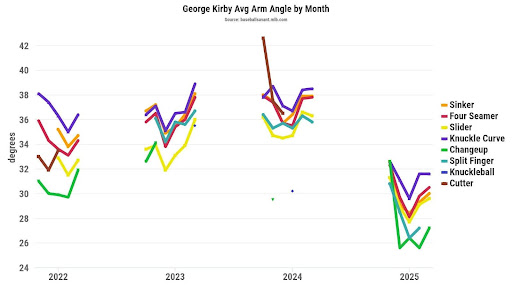
Kirby’s lower arm angle in 2025 led to the slider sweeping three inches more toward his glove side in 2025 compared to 2024. Besides Kirby’s slider, the four-seamer lost over two inches of induced vertical break while adding nearly an inch of arm-side run. Kirby’s arm angle dropped mainly from the vertical release point tumbling by over 2.5 inches and the horizontal release moving farther from his midline.
Theoretically, those arm angle changes for Kirby would lead to more horizontal pitch movement as we saw in 2025.
Kirby typically rocked elite control, with a career ball rate at 31%, which jumped to 34% in 2025, likely related to the shoulder injury. He finished the season healthy and saw an increase in his swinging-strike rate (12.4%), mainly via his knuckle curve (19% swinging-strike rate) and splitter (17.9% swinging-strike rate). However, it’s worth noting that Kirby ditched the splitter usage against left-handed hitters in 2025 (3.6%), down from 15.2% in 2024, so we dealt with a smaller sample.
Kirby still possesses high-end skills, with an xERA (3.36) nearly one run below his actual output in 2025. There’s a slightly discounted draft price for Kirby in 2026, and we’ll want to invest in him.
Kyle Bradish, Orioles (Yahoo ADP 79.6)
Kyle Bradish made it back healthy in late August 2025 after recovering from Tommy John surgery with an internal brace. It’s a small sample of six starts, but Bradish performed well with the expected ERA (2.89) and strikeout skills looking near-elite. That’s evident in Bradish’s 15% swinging-strike rate, mainly from the slider (21.7%) and curveball (23.4%) headlining the arsenal. Bradish was one of eight starting pitchers with two or more pitches with a swinging-strike rate above 20% in 2025.
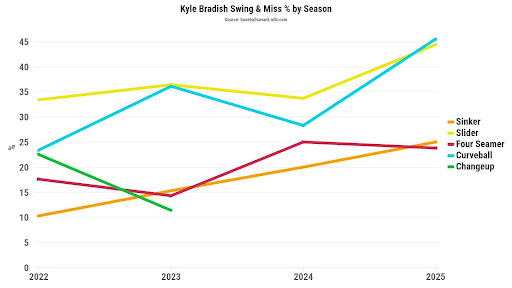
Bradish’s slider and curveball pitch movement profiles in 2025 looked similar to 2024, when he was on the brink of a breakout season before the injury. He has a consistent and optimal attack against right-handed hitters, with three more pitches (slider, sinker, four-seam) allowing a wOBA under .200 in 2025, similar to the outcomes in 2023 and 2024. Bradish weirdly threw more four-seamers (29.6%) to left-handed hitters after lowering the usage in 2024 (17.5%). That’s odd because left-handed hitters have been attacking the four-seamer, with a .457 wOBA (.464 xwOBA) in 2025, .703 wOBA (.612 xwOBA) in 2024, and .397 wOBA (.416 xwOBA) in 2023.
Expect Bradish to examine the data and adjust the pitch mix against lefties in 2026.
Even if the swinging-strike rate regresses to somewhat between 2025 (15%) and the career average (11.4%), Bradish profiles as an above-average to high-end starting pitcher based on the skills. That’s the type of pitcher to target in fantasy baseball drafts.
Starting Pitcher Fades
Bryan Woo, Mariners (Yahoo ADP 34.7)
It seemed like Bryan Woo’s arm might fall off in 2025, but he led the Mariners in innings, ahead of Luis Castillo. Unfortunately, Woo ended the season injured with a pectoral injury in mid-September. Woo wasn’t on the ALDS roster, then pitched in relief in the ALCS, though he wasn’t sharp in his 4.1 innings of work.
Woo is a WHIP asset, with 0.90 in 2024 and 0.93 in 2025, as he limits hit rate or BABIP. Meanwhile, Woo maintained near-elite control, with a career 31% ball rate. He has shown an increase in his ability to miss bats, with a 13.2% swinging-strike rate in 2025.
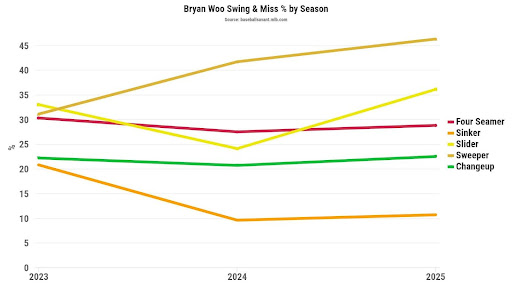
There used to be a narrative around Woo struggling against left-handed hitters. However, Woo has been throwing more changeups against lefties (12.4% in 2025 and 15.9% in 2024). Woo is a command artist, and he peppers the changeup low and away from left-handed hitters, and probably tunnels well with his sinker, which has a similar movement profile.
Woo has shown he can handle a heavy workload, though there’s still some injury risk at the draft cost.
Brandon Woodruff, Brewers (Yahoo ADP 133.8)
We spoke about Bradish’s small sample success, which might be ironic as we’re mentioning Brandon Woodruff as a starting pitcher fade. Woodruff missed nearly two full seasons after he underwent surgery in October 2023 on his throwing arm for the anterior capsule. The average timeline to return from this surgery was around 16 months for elite baseball players, according to a 2023 Study. It’s worth noting that the sample remains small, but that provides a rough timeline for other players, especially pitchers, who rely on throwing for their profession.
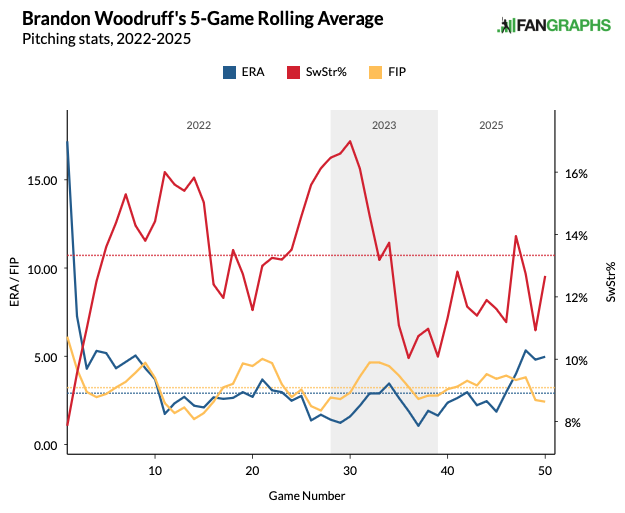
Woodruff found success with an average velocity under 93 mph (92.9 mph) in 2025 after a career average of 95.5 mph. There’s a chance that Woodruff’s velocity increases somewhere between 2025 and the career norms. Woodruff’s changeup was dropping two inches more and losing an inch of arm-side fade, with the lower velocity in 2025. Regardless, Woodruff’s changeup led his arsenal with a 20% swinging-strike rate.
Besides the lower velocity across the board and consistent changeup whiffs, he added a cutter in 2025; like a harder version of his slider. Woodruff found success with the cutter, especially against right-handed hitters, generating weak contact (.126 wOBA, .118 xwOBA). It could be a pitch classification issue, though Woodruff’s cutter looks like an intentional change to throw a harder slider based on the movement profile and pitch locations.
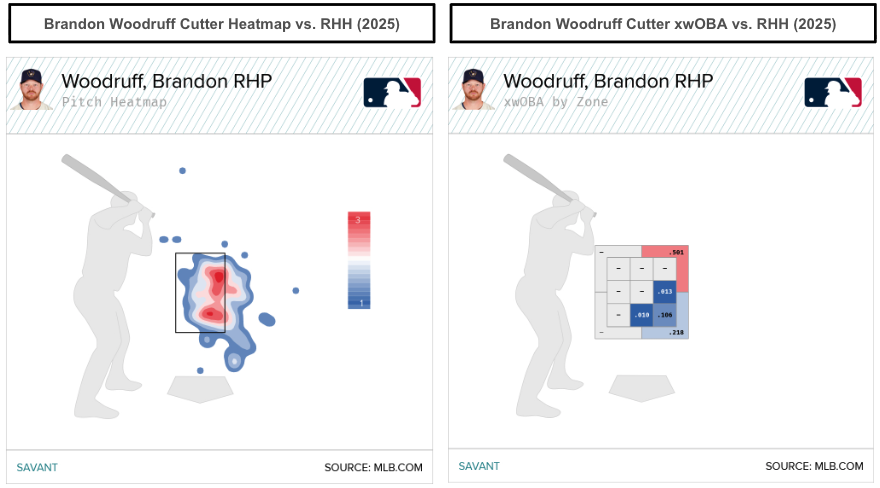
The main risk would be volume for Woodruff after missing nearly two seasons before returning in 2025. Most projections have him around 150 to 160 innings after he logged under 70 innings in 2025. If the velocity ticks up in Spring Training, then the injury optimism will rise, though we want to temper expectations on Woodruff returning to a near-elite starter. There is admittedly an upside scenario where Woodruff also evolves with the lower velocity and stuff.
Cam Schlittler, Yankees (Yahoo ADP 124.6)
There was some fortune in Cam Schlittler’s favor with a 3.72 xERA in 2025, nearly one run higher than his actual outcomes. Schlittler had mediocre control, with a 34% ball rate, yet a decent 12.1% swinging-strike rate. Although Schlittler has three pitches with double-digit swinging-strike rates, the four-seam (12.1%), cutter (10.4%) and sinker (11.1%) led the arsenal. That suggests Schlittler’s arsenal might be underwhelming from a whiff standpoint.
Schlittler’s four-seam possesses mediocre induced vertical break (16.3 inches) and below-average extension (6.4 feet, 39th percentile), which he locates in the upper third of the zone. The curveball generates above-average downward movement and horizontal sweep, a pitch Schlittler weirdly throws often (20.9%) to left-handed hitters with mediocre outcomes (.296 wOBA, .277 xwOBA). Typically, breaking pitches fare better against same-handed hitters.
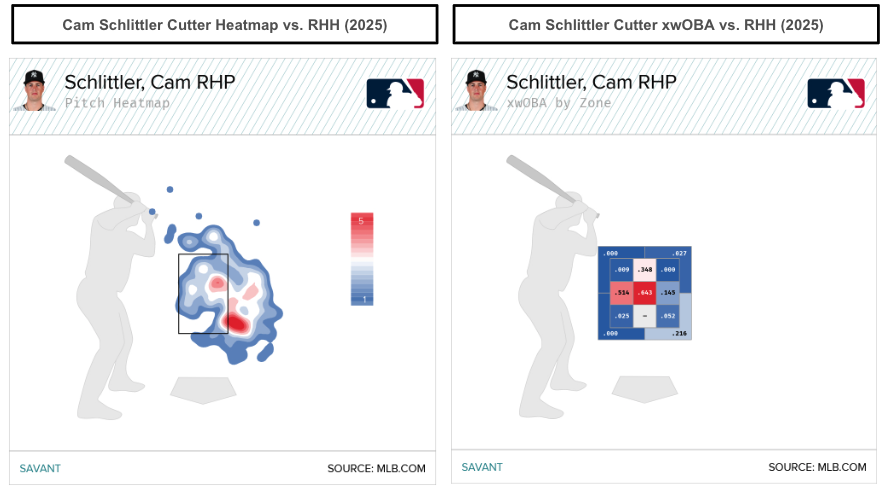
Meanwhile, Schlittler’s cutter tends to elicit weak contact (.192 wOBA, .202 xwOBA) against right-handed hitters, as he locates it low and away. However, Schlittler’s cutter doesn’t generate whiffs, evidenced by an 11.6% swinging-strike rate to right-handed hitters. He’ll need to find a more consistent approach to both sides of the plate, with only one solid offering to righties and lefties.
The draft market has been valuing Schlittler’s skills higher than the skills suggest, though there’s a chance we’re undervaluing the potential for a step forward. If a pitcher doesn’t have high-end stuff, lacks an above-average fastball and the secondaries don’t have above-average movement profiles to elicit whiffs (or weak contact), I tend to have caution with over-investing in this type of profile.
Starting Pitcher Sleepers
Kris Bubic, Royals (Yahoo ADP 208.7)
There’s probably some bias as a Kris Bubic truther heading into 2025. Bubic finished the season with a 3.65 xERA, 33% ball rate and 13.5% swinging-strike rate. The skills supported the breakout as a starting pitcher, though Bubic finished the season with a left rotator cuff strain in late July, causing him to miss the rest of the 2025 season. Bubic’s health concern has already been built into the early discounted draft price.
When we talked about Schlittler earlier and what we look for in breakout pitchers, Bubic checks those boxes. Bubic possesses an above-average four-seamer, generating 18.1 inches of induced vertical break, with 16 inches being around average. That, paired with high-end extension (85th percentile) while locating the four-seamer in the upper third of the zone, leads to an optimal combination for a fastball. We hear about those “rising” fastballs, and that’s what Bubic’s four-seamer theoretically does.
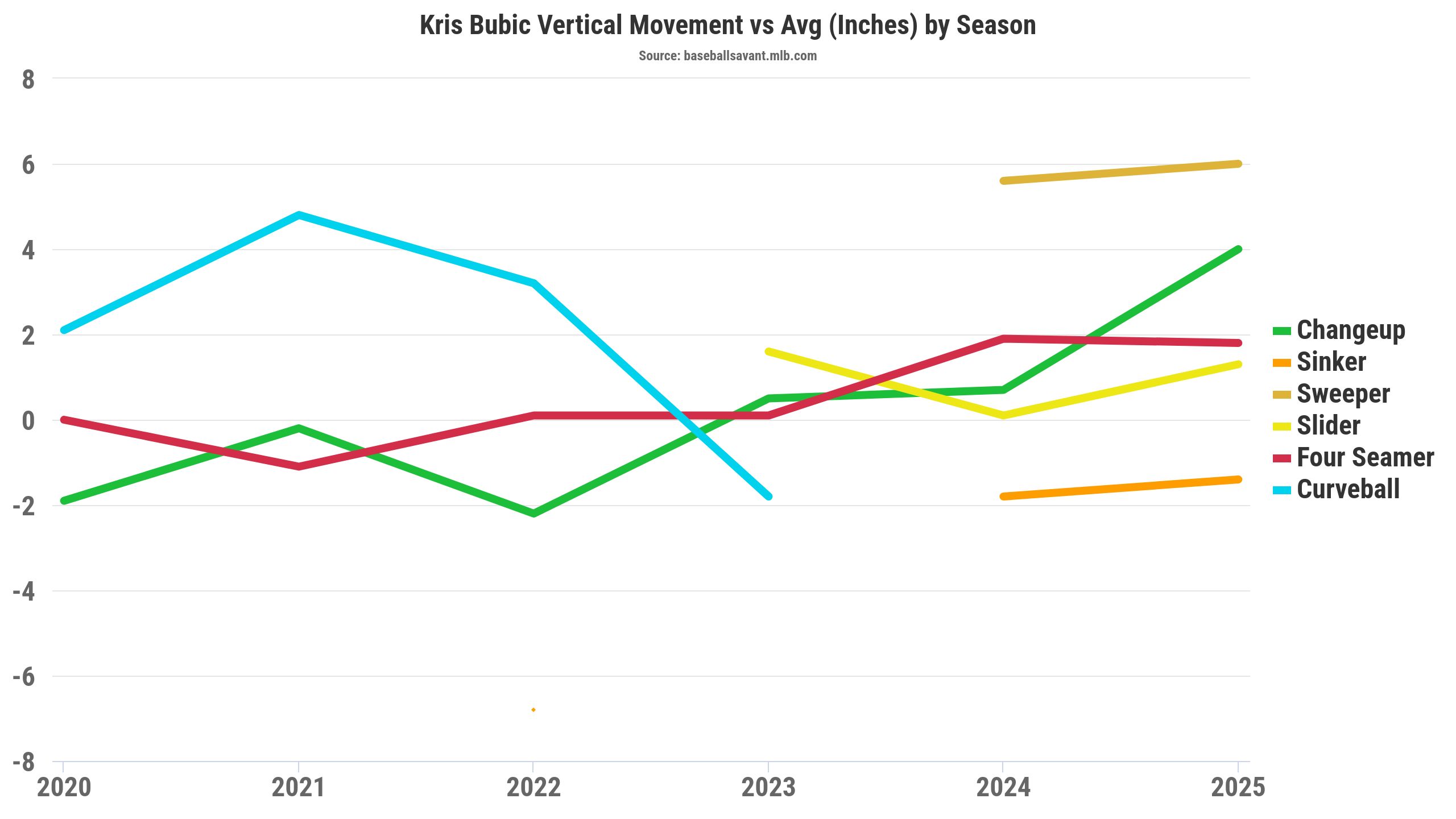
Bubic has a near-elite changeup that he peppers low and away from right-handed hitters, adding four inches of downward movement, which typically aligns with more whiffs from a vertical movement standpoint. Specifically, against right-handed hitters, Bubic’s changeup induced a 21.6% swinging-strike rate in 2025, better than 2024 (19.2%).
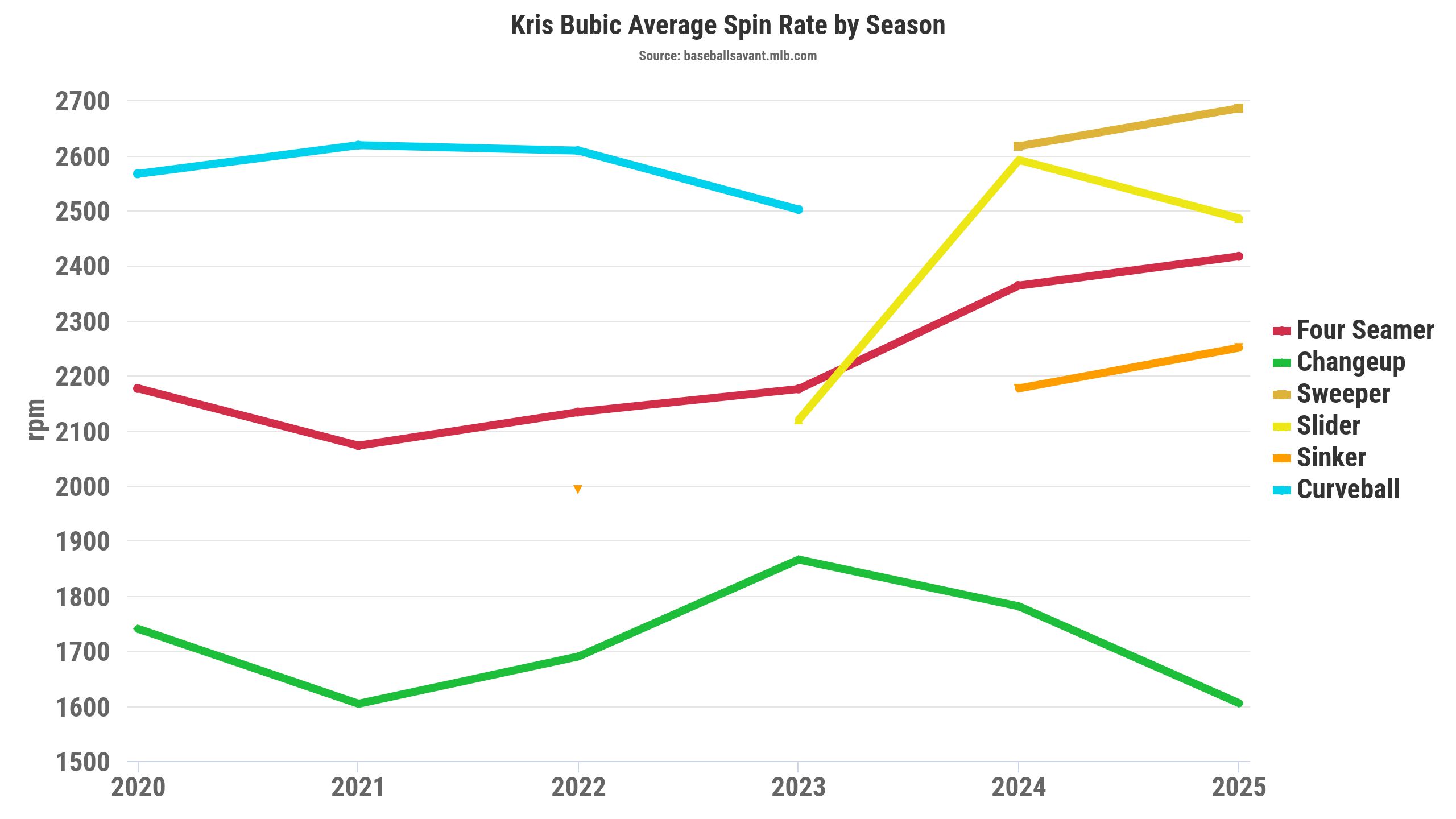
Let’s highlight a nerdy note about Bubic’s changeup. The changeup dropped more (four inches) and maintained velocity. How did that happen? Bubic probably threw the changeup with a different grip because the spin rate dropped by over 150 RPM, aligning with the additional inches of downward movement. Theoretically, that leads to more pitch separation between the four-seamer and the changeup, making it more challenging for hitters to cover the zone, as seen in the visual below.
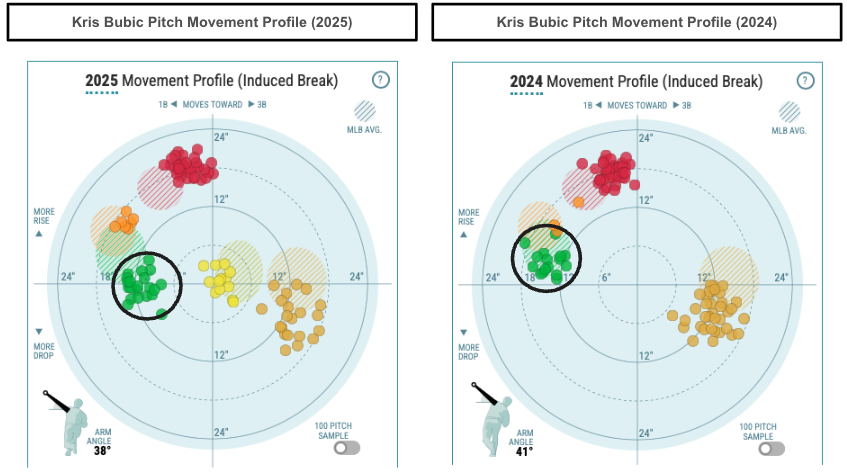
Take a chance on Bubic again in 2026 because there’s enough to like in his pitch movement profiles, approach and strikeout skills to replicate or take a slight step forward. The data supports Bubic’s semi-breakout from 2025 to buy back into him in 2026.
Ranger Suárez, Red Sox (Yahoo ADP 156)
The Red Sox signed Ranger Suárez in mid-January for five years and $130 million to add depth to their rotation. Suárez hasn’t shown the ability to handle an ace-like workload of 175-200 innings, but that’s not the likely expectation. He typically misses a month or so with an injury each season, though it’s hard to complain about 150 innings for someone who’s somewhat of a quality start machine. Suárez logged a quality start in 48% of his starts over the past four seasons (2022-2025).
Suárez goes deep into games via his heavy groundball approach, evidenced by his career 51% groundball rate, with the sinker leading the arsenal in groundballs (63-64%). Since Suárez pitches to contact, especially weak contact, his strikeout skills have been underwhelming with a 9.8% swinging-strike rate in 2025, identical with his career norm.
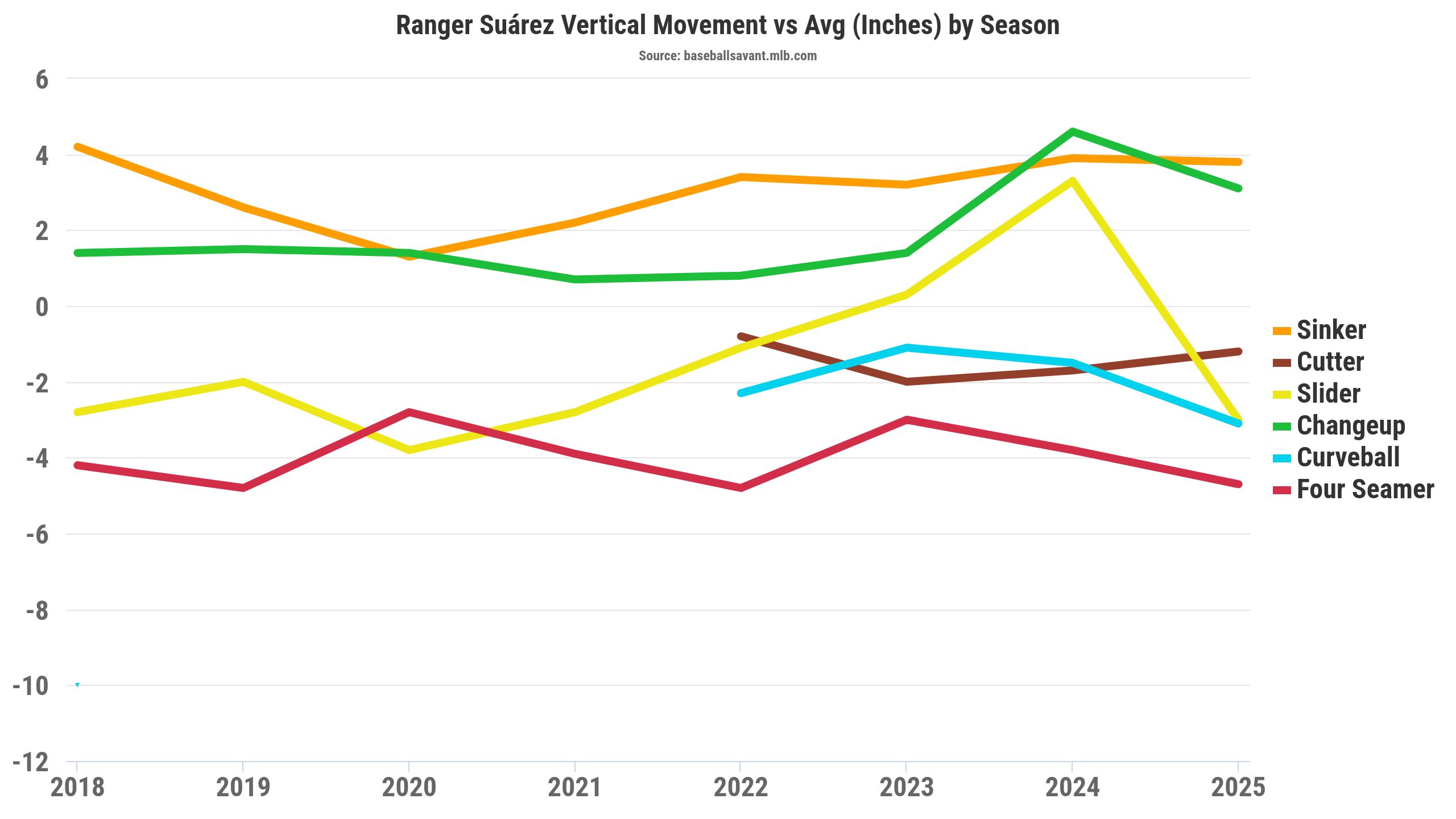
Although Suárez’s entire arsenal doesn’t generate whiffs, his changeup has been deadly, eliciting a 17.7% swinging-strike rate in 2025. Suárez’s changeup continues to drop an above-average rate (40-41 inches) over the past two seasons, as he commands the pitch low and away from right-handed hitters. The changeup serves as Suárez’s best pitch against right-handed hitters, allowing a .214 wOBA (.251 xwOBA) in 2025.
The Red Sox love cutters, throwing them at the second-highest rate in 2025. Suárez has a cutter, but it's one of his worst pitches from a movement and results (weak contact) standpoint. That’s evident by Suárez’s cutter allowing a .387 wOBA (.305 xwOBA) against right-handed hitters, which he threw 20.7% of the time. Since the Red Sox love cutters, I wonder if they make a tweak to Suárez's cutter.
From a fantasy roster construction standpoint, Suárez can eat quality innings while providing a solid floor, which we can pair with potential high-upside options at starting pitcher.
Top-12 Starting Pitchers Rankings
Tarik Skubal, Tigers
Paul Skenes, Pirates
Garrett Crochet, Red Sox
Yoshinobu Yamamoto, Dodgers
Hunter Brown, Astros
Cristopher Sánchez, Phillies
Jacob deGrom, Rangers
Logan Gilbert, Mariners
Chris Sale, Braves
Hunter Greene, Reds
George Kirby, Mariners
Logan Webb, Giants
You can find our complete starting pitcher rankings for the 2026 fantasy baseball season here.
Category: General Sports


